


From the Collaborative Bond and Money Market Data Portal
In the Collaborative Bond and Money Market Data Model, Ample Reserve System is an economic and monetary policy regime classification rather than a direct security-level field. Its mechanics directly govern the underlying benchmark curves, liquidity metrics, and pricing fields within the data model. This applies in particular to the Floating Rate Index (such as SOFR and EFFR), Repo, Commercial Paper (CP), and Certificates of Deposit (CD) instrument attributes.
Dictionary Definition
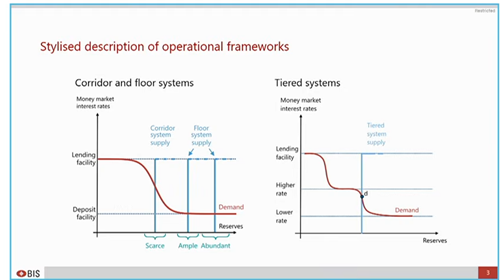
An Ample Reserve System (often referred to as a floor system) is a monetary policy implementation framework in which a central bank keeps banking-system reserves large enough that marginal changes in reserve balances do not materially affect short-term interest rates. In a scarce reserve or corridor system, as operated in the US before the global financial crisis, the central bank adjusted the daily quantity of a small stock of reserves to hit a target rate. Under ample reserves, it instead operates on the flat, elastic portion of the reserve demand curve. Policy rates are steered using administered rates. Interest on Reserve Balances (IORB) sets a benchmark for banks, while the Overnight Reverse Repurchase Agreement (ON RRP) facility provides a soft floor for non-bank money market participants.
1. Money Market Impact: Key Effects and Examples
Short-Term Rate Control and Volatility Suppression: With abundant liquidity, large daily swings in autonomous factors (such as Treasury General Account movements) do not cause rate spikes. The Effective Federal Funds Rate (EFFR) trades reliably within the central bank's target range.
Administered Floor Arbitrage: Non-bank institutions (such as Government-Sponsored Enterprises and Money Market Funds) do not earn IORB, so they lend cash below IORB. The ON RRP rate limits how far rates can fall below the policy floor. If short-dated CP or overnight Treasury repo rates fall below the ON RRP rate, Money Market Funds move large amounts of cash into the facility, which reinforces the floor.
Unsecured vs. Secured Volume Shifts: Abundant reserves remove the need for interbank overnight borrowing to meet end-of-day requirements. As a result, unsecured Fed Funds volumes stay small relative to the much larger secured repo volumes underlying SOFR. This makes secured overnight rates the primary reference for floating-rate money market instruments.
2. Bond Market Impact: Key Effects and Examples
Central Bank Balance Sheet Footprint: An ample reserve regime requires the central bank to hold a large portfolio of sovereign debt and agency mortgage-backed securities. This structural absorption of duration compresses the term premium on long-dated sovereign yields.
Bank Demand for High-Quality Liquid Assets (HQLA): Under Basel III Liquidity Coverage Ratio (LCR) rules, banks must hold enough HQLA to cover projected net cash outflows over a short stress period. Central bank reserves count as Level 1 HQLA with effectively no duration risk. When reserves are ample, banks hold more cash, which changes their marginal demand for intermediate-term Treasuries and agency debentures.
Swap Spreads and Corporate Credit: Predictable overnight funding stabilises dealer carry costs for warehoused inventory and dampens volatility in Treasury–swap spreads. It also reduces liquidity premiums in investment-grade corporate bonds and supports tighter bid-ask spreads across sovereign, supranational, and agency (SSA) curves.
3. Intermarket Linkages and Risk Scenarios
Transmission from Money Markets to Bond Yields: Administered rates anchor the front end of the yield curve. During Quantitative Tightening (QT), as the central bank lets bond holdings run off, private markets absorb more duration while liquidity drains first from the ON RRP facility, then from bank reserves. Once reserves approach the ample threshold, the central bank ends runoff and may resume bill purchases to keep reserves ample.
Scarcity Transition Risk (Repo Spike Scenario): The main operational risk is misjudging the threshold where reserves move from "ample" to "scarce". This threshold is often estimated relative to nominal GDP or bank assets. In the September 2019 repo episode, reserves reached the steep part of the demand curve and overnight repo rates spiked sharply. A severe funding shock of this kind can spread to bonds, as in the March 2020 market stress, when leveraged relative-value funds unwound cash-futures basis trades, Treasury-swap spreads widened, and CP issuance came under acute stress.
Inflation vs. Recession Regimes: In an inflationary scenario, an ample reserve system lets the central bank raise rates aggressively just by raising IORB and ON RRP, without selling bonds quickly. This avoids disorderly bond market fire sales. In a recession or banking-stress scenario, it provides an immediate liquidity buffer, though acute regional bank stress can still lead banks to hoard reserves, which temporarily fragments repo market transmission.
We are keen for registered CMDportal users to critical review dictionary items as well as make suggestions for new dictionary terms.